Central PA Spray Foam
Pole barn insulation done right starts with closed-cell spray foam. It bonds directly to steel panels, seals every seam and fastener, and stops the condensation that drips on equipment, hay, and livestock. Central PA Spray Foam insulates pole barns, post-frame shops, and metal buildings across central Pennsylvania from our home base in Lewisburg.
A pole barn’s thin steel skin swings with the outdoor temperature. When warm, humid air inside the building, from animals, a heated shop, or a wet floor, reaches that cold metal, it condenses. That “sweating” drips from the roof, rusts fasteners and purlins, and soaks whatever is stored below.
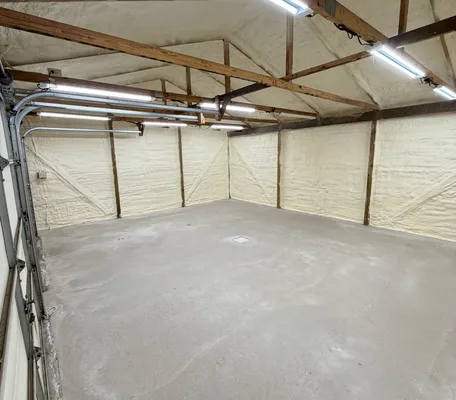
Closed-cell spray foam sprayed directly on the inside face of the steel air-seals the envelope and keeps the inner surface above the dew point, so moisture has no cold surface to form on. It delivers R-7.1 per inch, adds built-in vapor control, and gives the wall panels extra rigidity. Fiberglass batts are a poor match for steel: they sag over time and hold moisture against the metal.
Most dripping starts at the roof. Steel roofing radiates heat to the night sky and runs colder than the walls, so foaming the underside of the roof panels between the purlins does the most to stop condensation. Walls get foam between the girts, and doors and other openings are sealed at the framing so outside air can’t slip around the insulation.
Thickness is set by how you use the building. Pennsylvania livestock barns target R-15 to R-25 walls, with R-19 or more where animals are housed, and metal buildings in central Pennsylvania target R-15 to R-19. For reference, 2 inches of closed-cell foam is about R-14, and we spray to the thickness your building calls for.
Budget option: for a dry storage or hay barn with a finished ceiling liner, blown-in fiberglass over the ceiling can work. On the roof itself, we spray foam on the inside face of the roof panels.
Farm & Shop Buildings
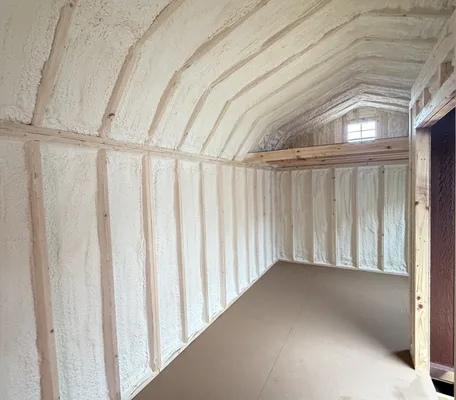
Every post-frame building gets used differently, and the use decides where the foam goes and how thick it needs to be.
Pre-engineered steel buildings face the same physics as a pole barn, at a larger scale. Steel conducts heat and cold straight through, every girt and fastener is a thermal bridge, and condensation risk peaks during the spring and fall temperature swings.
Closed-cell spray foam answers all three in one layer: it is the continuous insulation, the air barrier, and the vapor retarder. We insulate steel shops, equipment buildings, storage buildings, and small commercial steel buildings across Pennsylvania. For larger facilities, see our commercial metal building insulation page.
Building codes usually require spray foam to be covered by a thermal barrier, such as drywall, or in some attics and crawl spaces by an ignition barrier, depending on how the space is used. An occupied workshop or a livestock area is treated differently than unoccupied storage. We go over what your building’s use requires during the free inspection, so there are no surprises when the foam is in place.
How We Work
We measure the walls, roof, and openings and look for moisture and ventilation issues that affect the plan.
You get an itemized estimate with no hidden fees. Pricing depends on the square footage and the foam thickness your building needs.
Clear a few feet along the walls and cover or move equipment. We mask windows, doors, and electrical boxes before spraying.
Closed-cell foam is applied in passes until it reaches the target thickness on the walls, the roof, or both.
The building is ventilated while the foam cures. Following Natural Polymers’ guidance, we tell you when it is safe for people and animals to return.
We do a final walkthrough with you. Our workmanship warranty covers the install, and the material warranty comes from the manufacturer.
Let’s Talk
Call or send us a message to schedule a free pole barn inspection, and we’ll walk the building with you and put together a written estimate.
(570) 412-5613 Get a Free EstimateWe come to you. That includes Union and Snyder County farms around Lewisburg, Mifflinburg, and Selinsgrove; Penns Valley and Nittany Valley farms toward Bellefonte and State College; the Kishacoquillas Valley around Lewistown; and the Cumberland Valley around Carlisle and Harrisburg.
Most inspections and quotes happen within days. Whether you have a new post-frame shop or an older barn that drips every spring, see our central Pennsylvania service area for the full list of towns we cover, or call to confirm your location.
Your Questions Answered
Closed-cell spray foam. It bonds directly to steel panels and framing, acts as its own vapor barrier to stop condensation, adds rigidity to walls and roof, and holds up to the moisture in livestock barns. Blown-in fiberglass can be a budget option for a dry storage or hay barn ceiling, and we'll tell you which fits your building.
Condensation forms when warm, humid air touches cold steel. Closed-cell spray foam sprayed directly onto the metal keeps the inside surface above the dew point and blocks humid air from reaching the steel at all. In livestock barns, pair the foam with good ventilation, because animals add a lot of moisture to the air.
Often, yes. Building codes generally require foam in occupied spaces to be covered by an approved thermal barrier, such as half-inch drywall, or an approved coating. Some agricultural buildings and spaces entered only for service follow different rules. The requirement depends on how the building is used, so we review it with you during the free inspection.
You can, but if you only do one, start with the roof or ceiling. Heat rises, and most condensation drips from the underside of the roof steel, so the roof matters most. Insulating only the walls leaves the roof sweating. Doing both gives you a sealed envelope and the most even temperatures, and your free quote can price each area.
The building should be dried in, with the roof, doors, and windows installed. Finish any electrical and plumbing rough-in inside the walls, move equipment, stored materials, and animals a few feet away from the walls, and make sure the steel is clean and dry. We walk through the prep list with you before the install date.
Most pole barns are sprayed in one to three days, depending on the building's size, whether we're insulating the walls, the roof, or both, and how much prep is needed. Large metal buildings and commercial shops can take longer. You'll get a clear timeline along with your free inspection and quote.
Properly installed closed-cell spray foam can last 50+ years, which covers the life of most pole barns. It doesn't sag, settle, or slide down the wall, and it keeps its R-value because it resists the moisture and nesting mice that ruin fiberglass batts and loose blankets in barns.
We insulate pole barns, post-frame shops, and metal buildings throughout central Pennsylvania: farm country from the Buffalo Valley to Penns Valley and the Cumberland Valley.
Our home base. Full insulation service for Lewisburg, Mifflinburg, Milton, Danville, Sunbury, Selinsgrove, Bloomsburg, and the surrounding communities.
Homes, businesses, and new builds across Harrisburg, Camp Hill, Mechanicsburg, Hershey, Carlisle, and the greater capital area.
Insulation for the Centre County region — State College, Bellefonte, Boalsburg, Philipsburg, and the surrounding valleys.
Between those three points is our core service area, and we cover plenty of ground around them — including Williamsport, Lock Haven, and Lewistown. If your town isn’t listed, call us. We’ll cross state lines for the right project, too. Learn more on our service area page, or reach out to confirm coverage and schedule a free inspection.
(570) 412-5613 Contact UsWhether your barn drips on equipment, houses animals, or is about to become a heated shop, it starts with a free inspection. We look at the building, talk through how you use it, and give you an honest, itemized estimate.
Central PA Spray Foam is family-owned and operated, licensed in Pennsylvania (HIC #PA197062), and installs Natural Polymers closed-cell spray foam and Owens Corning blown-in fiberglass.

© Red Barn Media Group 2026